The product that caught my attention
Reading about OpenAI’s Dots sent me down another rabbit hole. OpenAI describes a dot as an ongoing agent that can work across tools and projects, retain relevant context, and return with results or decisions. Its documentation says Dots are powered by GPT-6 Astra and are rolling out gradually to eligible accounts. That makes me curious about the entire product around the model: how does it know what matters, when to act, and when to ask?Source: Meet dots — official OpenAI documentation.
What the model is actually doing
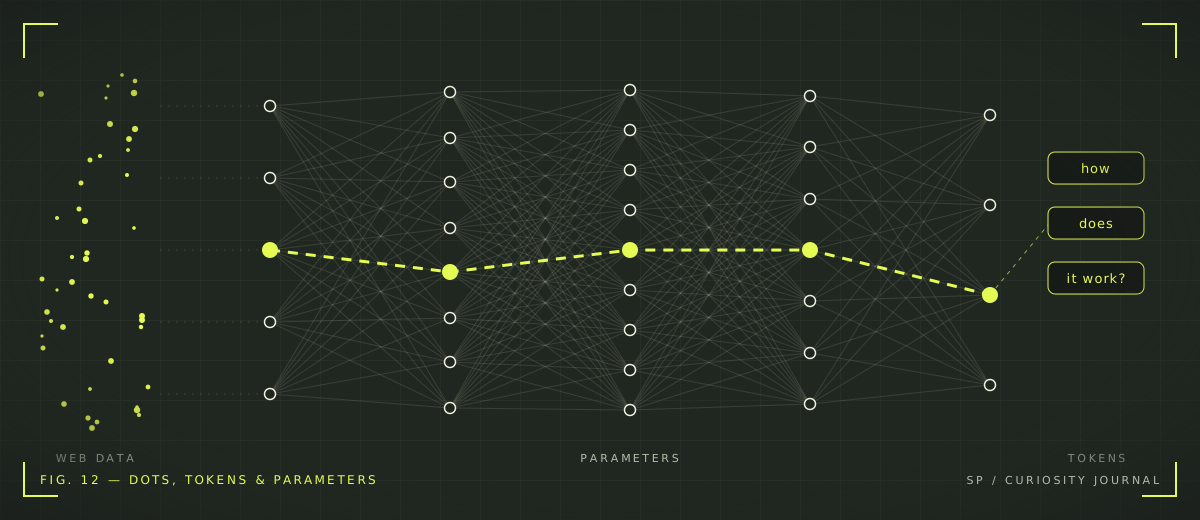
Here’s the distinction I’m learning to make. Tokens are the chunks of text a model processes. Parameters are learned numerical values inside it. During training, prediction errors guide adjustments to those values. In a typical autoregressive language model, generating an answer means repeatedly estimating the next token from the preceding context. Transformer attention helps relate parts of that context. The fluency is impressive; it does not guarantee that every statement is true.Source: Google’s introduction to Transformers.
The internet is a messy classroom
Web scraping sounds simple until you think about the input: menus, advertisements, copied pages, broken formatting, and genuine knowledge all mixed together. Hugging Face’s FineWeb work documents how text extraction, filtering, and removing duplicates affect training data. Collecting pages is only the beginning. My question becomes: what did the cleaning process keep, what did it throw away, and how did the team check that those choices improved the model?Source: FineWeb’s dataset research.
More parameters is only part of the story
The 2022 Chinchilla paper gave me a useful counterexample to judging a model by its parameter count alone. Its researchers trained a 70-billion-parameter model with more training data, using the same compute budget as the larger Gopher, and reported better performance across many evaluations. The lesson I take from that experiment is about balance: model size, data, and compute interact. A bigger number on a launch slide is not a complete explanation of capability.Source: Hoffmann et al., Training Compute-Optimal Large Language Models.
Where the business question begins
OpenAI’s API pricing meters text usage in input and output tokens, with separate pricing categories such as cached input. That is different from charging by parameter count. My commercial question is whether the result is worth the total cost: computation, waiting, verification, and fixing mistakes. More usage can create revenue, but more tokens do not automatically mean more profit. I’d want to measure cost per successfully completed task, alongside quality and time saved.Source: OpenAI API pricing.
Why Dots feels like a product question
An agent that keeps working needs clear boundaries. OpenAI’s controls documentation describes action reviews based on instructions, permissions, and safeguards. For me, the interesting design challenge is deciding when an agent should continue independently and when a person needs to make the call. That connects directly to my interest in risk and product design. Useful autonomy has to earn trust through results people can inspect and decisions they can understand.Source: Control your dot — official OpenAI documentation.
The question I want to keep asking
I’m approaching this as a curious learner with a strategy and analytics background. I haven’t benchmarked Dots, and this is a reflection on its documentation rather than a hands-on review. What excites me is learning how the pieces fit: data becomes a model, a model becomes part of a product, and that product has to solve something people care about. Which AI workflow has actually saved you time once you include the checking and rework?
The metric I keep coming back to: useful work completed, with a result I can trust.
Something here sparked another question?
Let’s talk about it